Ask natural-language questions over real SEC filings — and get answers grounded in the source documents, with citations you can click through to EDGAR.
SEC annual and quarterly reports are among the richest public sources of corporate information in the world. They are also long, repetitive, and poorly served by keyword search. A question like “Did Goldman Sachs’ board approve a buyback program?” or “Who are the elected directors?” should not require reading hundreds of pages of inline XBRL HTML.
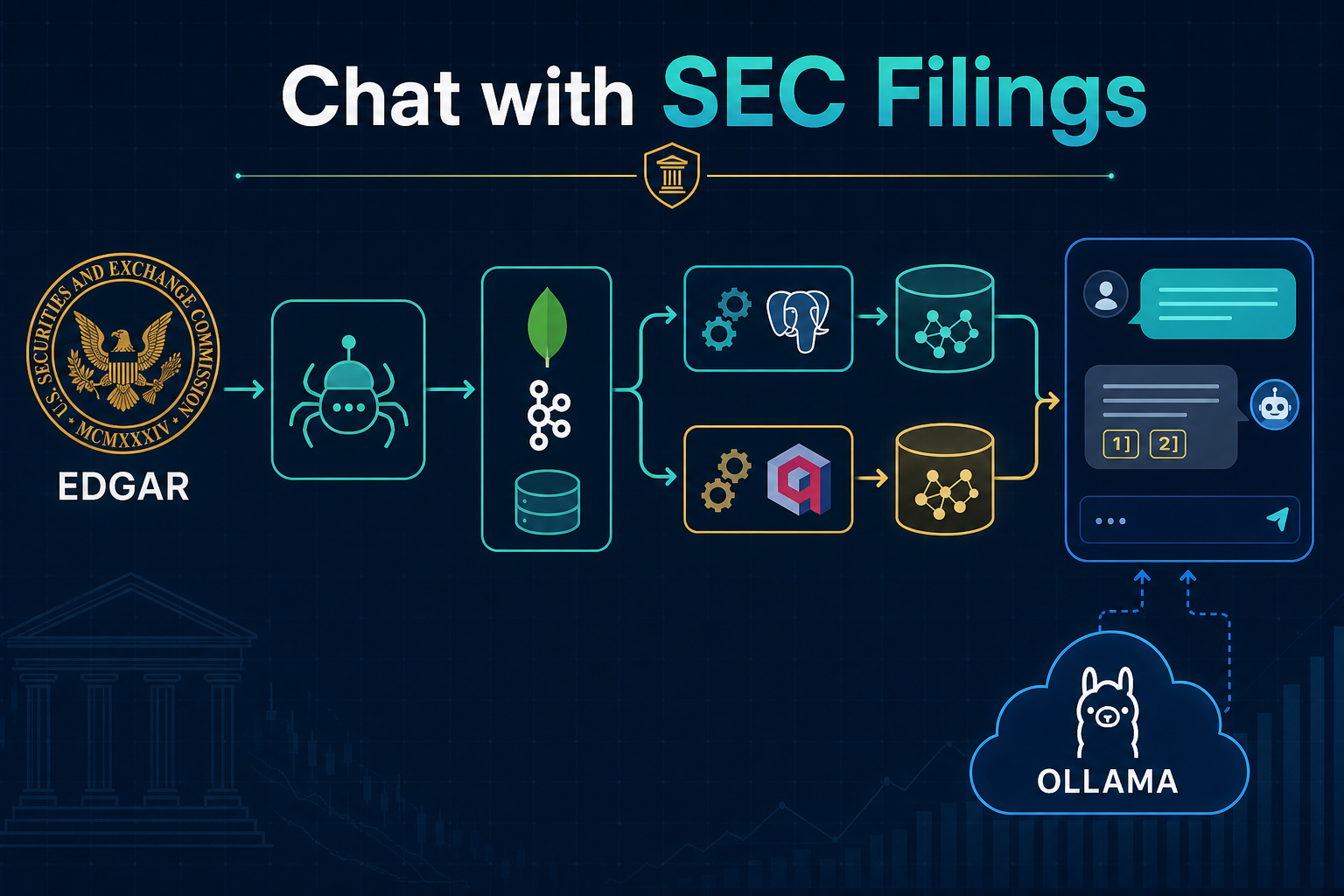
This post summarizes the architecture behind Chat with SEC Filings — a multi-repo, event-driven RAG pipeline I built to make that kind of question answerable locally, with cited sources and no cloud LLM dependency.
The Problem
Corporate filings on EDGAR are technically public, but practically opaque:
- Volume — the S&P 500 alone generates thousands of 10-K, 10-Q, and 8-K filings every year.
- Format — primary documents are inline XBRL HTML, not clean prose.
- Search limits — EDGAR’s native search is accession- and keyword-oriented, not semantic.
- Analyst workflow — comparing language across quarters, tickers, or sections still means manual reading.
The goal was not a demo that calls an API once. It was a repeatable pipeline: ingest filings automatically, index them for semantic retrieval, and expose a chat interface that cites the passages it used.
Design Principles
Several decisions shaped the architecture:
- Event-driven decoupling — downloading, parsing, and embedding are separate services connected by Kafka. A new filing triggers downstream indexing without tight coupling.
- Local-first — filings live on disk; embeddings and vectors stay on your machine. Ollama runs the LLM locally (
qwen3:30bfor generation,bge-m3for embeddings). - Dual vector backends — the same ETL pipeline feeds both pgvector (PostgreSQL + ParadeDB BM25 hybrid search) and Qdrant, so retrieval strategy can be compared without re-ingesting filings.
- Grounded answers only — the LLM receives retrieved chunks and a system prompt requiring inline
[1],[2], … citations with SEC EDGAR links. No retrieval, no answer. - Composable repos — each stage is its own GitHub repository with a published Docker image. A seventh repo wires them together with Compose.
The Six Repositories
| Repository | Role | Stack |
|---|---|---|
| sec-edgar-filings-crawler | Download S&P 500 filings from EDGAR; store metadata in MongoDB; publish Kafka events | Python, FastAPI, MongoDB, Kafka |
| sec-edgar-filings-to-pgvector | Kafka consumer: read .htm from disk, chunk, embed, load pgvector | Python, sentence-transformers, ParadeDB |
| sec-edgar-filings-to-qdrant | Same pipeline into Qdrant | Python, sentence-transformers, Qdrant |
| sec-edgar-filings-semantic-search-ui | Single-turn RAG search with cited answers | Spring Boot 3.4, Spring AI, Thymeleaf |
| sec-edgar-filings-chat | Multi-turn conversational RAG with session history | FastAPI, Jinja2, psycopg / Qdrant REST |
| sec-edgar-filings-rag-demo | One-command Docker Compose for the full stack | Compose only — no application source |
The chat app is the capstone. The crawler and ETL repos are the foundation everything else depends on.
End-to-End Architecture
flowchart TB
    Wiki["Wikipedia<br/>S&P 500 constituents"] --> Crawler["sec-edgar-filings-crawler"]
    SEC["SEC EDGAR API"] --> Crawler
    Crawler --> Mongo[("MongoDB<br/>filing metadata")]
    Crawler --> Kafka[["Kafka<br/>filings topic"]]
    Crawler --> Disk["Local disk<br/>.htm filings"]

    Kafka --> ETL["sec-edgar-filings ETL"]
    Mongo --> ETL
    Disk --> ETL

    ETL --> VectorStore[("Vector store<br/>+ BM25 search")]
    VectorStore --> Chat["sec-edgar-filings-chat"]
    Chat --> Ollama["Ollama<br/>bge-m3 + qwen3"]
    Ollama --> Chat
Retrieval backends: The diagram shows one indexing path, but the same Kafka events can feed either backend. pgvector + pg_search (ParadeDB) combines dense embedding similarity with sparse BM25 lexical search, fused via reciprocal rank fusion (RRF). Qdrant offers the same dense + sparse pattern with its own vector and full-text APIs. Pick one in the chat UI — no need to re-crawl filings.
Stage 1 — Ingest (Crawler)
The crawler resolves S&P 500 tickers to SEC CIKs (cached in MongoDB), lists recent filings from EDGAR submissions, and downloads each filing’s primary document if not already recorded.
For every newly registered filing it:
- Writes the
.htmfile to local disk (bind-mounted external storage in Docker). - Upserts metadata into MongoDB (
filing_metadata: ticker, form, accession number,local_path, dates). - Publishes a
filing.downloadedevent to Kafka when enabled.
Supported forms include 10-K, 10-Q, and amendments. Class-share tickers (BRK.B / BRK-B) normalize correctly. A FastAPI admin UI supports batch jobs (refresh-sp500, download-sp500) and a browse UI for inspecting stored data.
Stage 2 — Transform & Index (ETL Consumers)
Both ETL services are Kafka consumers that never call EDGAR directly. They react to events, look up metadata in MongoDB, and read the file from disk:
- Parse — extract readable text from inline XBRL HTML.
- Chunk — split into passages sized for retrieval.
- Embed —
BAAI/bge-m3via sentence-transformers (1024 dimensions). - Load — upsert into pgvector (
filings+filing_chunkswith HNSW index) or Qdrant (filing_chunkscollection).
Idempotency is built in: if an accession number already exists in the vector store, the consumer skips and commits the Kafka offset.
The pgvector path adds hybrid retrieval — vector similarity plus BM25 full-text search via ParadeDB’s pg_search, fused with reciprocal rank fusion (RRF). That helps when a question uses exact financial terms (“EBITDA”, “Section 16”) that pure embedding search might miss.
Stage 3 — Retrieve & Generate (Chat)
sec-edgar-filings-chat orchestrates the RAG loop on each user message:
sequenceDiagram
    participant Browser
    participant Chat as FastAPI /chat
    participant Conv as ConversationStore
    participant RAG as RagSearchService
    participant Embed as Ollama bge-m3
    participant VStore as pgvector or Qdrant
    participant LLM as Ollama qwen3

    Browser->>Chat: POST message + filters
    Chat->>Conv: load session
    Chat->>RAG: continue_conversation
    RAG->>Embed: embed query (expand short follow-ups)
    Embed-->>RAG: 1024-dim vector
    RAG->>VStore: top-K search (+ ticker/form filters)
    VStore-->>RAG: filing chunks
    RAG->>LLM: prior turns + chunks + citation prompt
    LLM-->>RAG: answer with [1][2] citations
    RAG-->>Chat: updated conversation
    Chat-->>Browser: thread + source cards + EDGAR links
Key behaviors:
- Multi-turn context — prior user and assistant turns are sent to the LLM; short follow-ups (“What about Q2?”) are expanded using the previous user message before embedding.
- Configurable retrieval — chunk count presets (10 / 25 / 50 / 100) or any value up to 500; optional ticker and form filters.
- Dual vector store switch — pgvector or Qdrant selectable in the UI without re-indexing.
- Session management — signed cookie stores up to 40 turns; “New conversation” clears context.
- Transparency — each turn shows retrieval time, generation time, model, vector store, and expandable source cards.
The earlier semantic-search-ui repo implements the same RAG pattern as a single-turn Spring Boot + Spring AI app. The chat repo reimplements it in FastAPI with conversation state — same retrieval contracts, different UX.
Running the Full Stack
sec-edgar-filings-rag-demo wires everything with Docker Compose. One docker compose up brings up:
| Service | Port | Purpose |
|---|---|---|
| Crawler (Admin + Browse) | 18080 | Download and inspect filings |
| pgvector Search UI | 18000 | Chunk retrieval only (no LLM) |
| Qdrant Search UI | 18002 | Chunk retrieval only |
| RAG Search Interface | 18095 | Single-turn cited answers |
| Kafka debug UI | 18081 | Optional message inspection |
| MongoDB | 10017 | Metadata |
| Kafka | 10092 | Event bus |
| pgvector DB | 10432 | PostgreSQL + vectors |
| Qdrant | 16333 | Vector collection + dashboard |
Ollama runs on the host (localhost:11434), not in a container — so GPU acceleration on a Mac or Linux box applies to both embedding and generation.
Typical bootstrap:
- Refresh S&P 500 tickers from Wikipedia, then run a download job.
- ETL consumers pick up Kafka events and populate both vector stores in parallel.
- Open the chat UI, select pgvector or Qdrant, pull
bge-m3andqwen3:30b, and ask a question.
What We Achieved
Concrete outcomes from this work:
- Automated S&P 500 coverage — filings download, deduplicate, and index without manual file handling.
- Production-shaped boundaries — clear producer/consumer contracts (Kafka event schema, MongoDB metadata, shared disk paths) that allow each service to deploy and scale independently.
- Comparable retrieval backends — identical chunks in pgvector and Qdrant, with hybrid BM25+vector on the Postgres path.
- Grounded, cited answers — every response links back to the SEC EDGAR filing it came from.
- Local privacy — no filing content or questions leave your machine unless you choose to.
- Published Docker images — every application repo builds and publishes to Docker Hub; the demo repo is glue only.
- Two chat implementations — Spring AI (single-turn) and FastAPI (multi-turn), sharing the same vector schemas.
Example questions that work well today:
Do you know if the Adobe board approved a buyback program?
Who are the elected directors in Goldman Sachs?
Filter by ticker (GS) and form (10-K) to narrow retrieval when you know the target filing.
Screen recording of the chat UI answering a filing question with cited sources.
What Comes Next
The current pipeline answers “what do the filings say?” well. Several extensions would move it toward “what do the filings mean together?”
Knowledge Graph
Vector search retrieves similar passages. A knowledge graph would capture entities and relationships across filings:
- Companies, officers, directors, subsidiaries, auditors
- Events: acquisitions, restatements, material weaknesses, buyback authorizations
- Temporal edges: “Director X joined in Q2 2024”, “Segment Y was renamed in the 2023 10-K”
A practical path:
- Extract structured entities from chunked text (NER + LLM-assisted relation extraction during ETL).
- Store in Neo4j, Apache AGE (Postgres extension), or DuckDB with graph queries — co-located with existing Postgres infrastructure.
- Hybrid retrieval — vector search for prose questions, graph traversal for relational questions (“Which S&P 500 companies changed auditors in the last two years?”).
- Fusion at answer time — pass both chunk context and subgraph summaries to the LLM.
The Kafka event bus already provides the hook: a third consumer could build the graph incrementally on each filing.downloaded event, the same way pgvector and Qdrant consumers do today.
MCP Tools
Model Context Protocol tools would expose the pipeline to Claude, Cursor, and other MCP clients without a custom web UI:
| Tool | Description |
|---|---|
search_filings | Semantic search with ticker/form filters; returns ranked chunks |
ask_filing | Full RAG answer with citations for a single question |
list_filings | Query MongoDB metadata — recent 10-K/10-Q by ticker |
get_filing_section | Fetch a specific accession or section from disk |
compare_filings | Diff language across two accession numbers (e.g., risk factors YoY) |
An MCP server sitting in front of the existing FastAPI services would reuse RagSearchService and the chunk repositories — no re-architecture required. Agents could chain tools: list recent filings → search within one → ask a follow-up with graph context.
Other Improvements
- Broader universe — extend beyond S&P 500 to Russell 2000, ETFs, or custom watchlists.
- Section-aware chunking — tag chunks with Item 1A (Risk Factors), Item 7 (MD&A), etc., for filtered retrieval.
- Evaluation harness — golden questions with expected citations to regression-test retrieval quality across embedding model or chunk-size changes.
- Observability — metrics on ingest lag (Kafka offset vs. EDGAR filing date), retrieval latency, and citation accuracy.
Closing Thought
SEC filings are a stress test for information systems: messy HTML, legal language, high stakes, and readers who care about provenance. Building Chat with SEC Filings meant treating ingest, index, retrieve, and cite as separate engineering problems — connected by events, not monoliths.
The repos are open source and MIT-licensed. Start with the RAG demo for a one-command stack, or run sec-edgar-filings-chat against an existing pgvector or Qdrant index.
If you are working on financial document AI — knowledge graphs, MCP tooling, or evaluation — I’d welcome collaboration on the next layer.
Repository Index
- sec-edgar-filings-crawler — EDGAR downloader + Kafka producer
- sec-edgar-filings-to-pgvector — Kafka → pgvector ETL + hybrid search
- sec-edgar-filings-to-qdrant — Kafka → Qdrant ETL
- sec-edgar-filings-semantic-search-ui — Single-turn RAG (Spring Boot)
- sec-edgar-filings-chat — Multi-turn conversational RAG (FastAPI)
- sec-edgar-filings-rag-demo — Full-stack Docker Compose