A strategic improvisation. This post is a thesis—a thought exercise on how PayPal could extend its network into merchant finance. It describes what a PayPal Capital Network might look like, not what PayPal is building today. It is not investment advice, a product review, or a statement of PayPal’s actual plans. For the broader platform vision, see The Trillion-Dollar PayPal Thesis.
PayPal already lends to merchants through Working Capital and partner-backed business loans. When PayPal provides that capital, PayPal takes the credit risk. That is balance-sheet lending—a real business, but not the full opportunity.
The larger thesis is different:
PayPal enters the private credit market as a platform—connecting wealthy individuals to trustworthy local businesses, with flexible collateral and automated repayment, while PayPal provides trust, infrastructure, and servicing—not the capital itself.
That is the vision of the PayPal Capital Network.
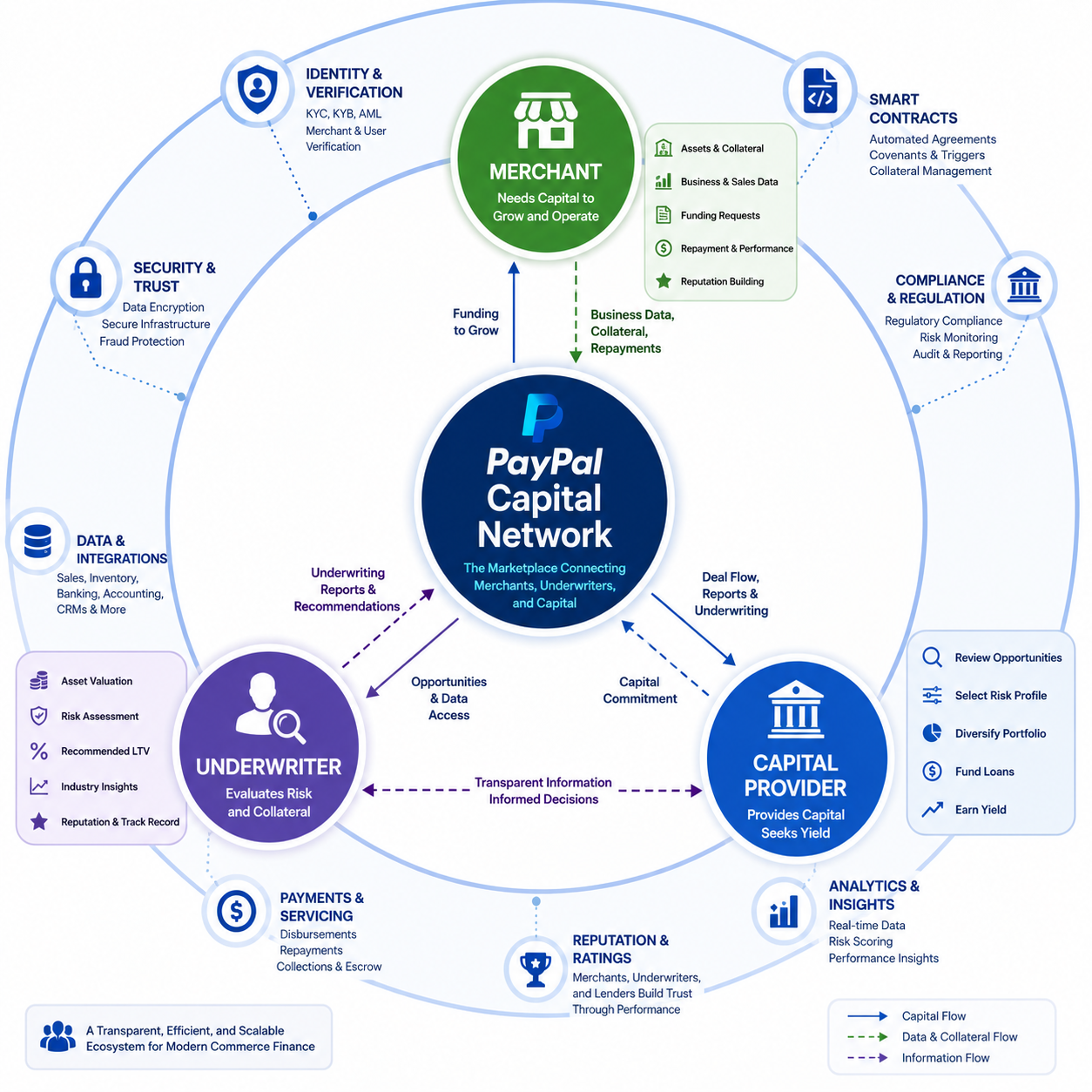
A platform model: wealthy individuals fund local businesses they can evaluate and trust, with PayPal providing identity, collateral workflows, and repayment infrastructure.
Two Models, One Platform
These should not be conflated:
| Model | Who provides capital | Who takes credit risk | PayPal’s role |
|---|---|---|---|
| Working Capital | PayPal (or a bank partner) | PayPal (or the partner) | Lender |
| Capital Network | Wealthy individuals, family offices, private credit funds | The capital provider | Platform operator |
When PayPal funds a merchant directly, it is a lender with skin in the game. When PayPal connects a merchant to an individual investor, it is infrastructure—the marketplace operator earning fees on origination, servicing, and trust.
The Capital Network does not replace Working Capital. It opens a layer above it.
The Core Idea
Private credit today is relationship-driven. A wealthy individual who wants yield outside public markets typically works through a fund manager, a family office intermediary, or a broker who sources opaque deals. A local restaurant owner, retailer, or contractor who needs $200,000 to expand cannot reach that capital directly.
PayPal sits between them—with something neither side has alone:
- For the merchant: verified identity, years of payment history, and a reputation score built from real commerce
- For the investor: standardized deal packages, ongoing performance monitoring, and automated repayment through payment rails
- For both: contracts, compliance, and a platform that handles the operational complexity
Local Business (Merchant)
         ↕
Wealthy Individual / Family Office (Capital Provider)
         ↕
      PayPal
   (trust, platform, servicing)
In the mature form, a third participant joins for complex deals: independent underwriters who value collateral PayPal cannot assess from payment data alone—land, equipment, inventory, gold, or crypto held in custody.
Why Trustworthy Local Businesses
The word trustworthy is doing deliberate work here.
PayPal does not connect strangers on the internet to fund unvetted borrowers. It connects capital to merchants whose commercial behavior PayPal has already observed—often for years:
- Payment volume and growth trends
- Refund and chargeback patterns
- Account tenure and stability
- Dispute history
- Customer concentration and seasonality
A merchant processing $100,000 in sales per day through PayPal for three years is not an unknown credit risk. They are a verified business with a measurable track record—exactly the kind of borrower a wealthy individual would consider if the information were packaged and the repayment automated.
This is how PayPal enters private credit without becoming a bank: it exports the trust it has already built through payments into a new asset class.
Collateral Is Not One Thing
Traditional lending forces collateral into narrow categories. The Capital Network treats collateral as whatever secures repayment—with the underwriting workflow adapting to the asset type.
| Collateral type | Example | How repayment or recovery works |
|---|---|---|
| Daily cashflow | $100K/day in PayPal sales; merchant agrees to pay 5% of daily revenue until repaid | Automated sweep from payment flows |
| Inventory | $500K in warehouse stock for a seasonal retailer | Underwriter values stock; lien on inventory; field exam on default |
| Equipment | Commercial kitchen, manufacturing line, delivery fleet | Appraised value; UCC filing; repossession on default |
| Real estate | Land, storefront, warehouse | Title search; appraised LTV; mortgage lien |
| Precious metals | Gold held in verified custody | Custodian attestation; LTV against spot price |
| Crypto assets | BTC or stablecoins in platform-linked custody | Mark-to-market; margin calls on volatility; liquidation thresholds |
| Receivables | Outstanding invoices from verified buyers | Assignment of receivables; collection on default |
The simplest and most PayPal-native form is cashflow collateral:
A merchant processing $100,000 in sales per day agrees to direct 5% of daily PayPal revenue—$5,000 per day—to the lender until the obligation is satisfied.
No quarterly financials. No broker. No manual ACH. The collateral is the revenue stream, and PayPal already sits on the pipe that collects it.
More complex collateral—land, gold, crypto—requires underwriters, custody arrangements, and legal perfection. But the platform model is the same: merchant posts collateral, investor provides capital, PayPal handles contracts and servicing.
What the Merchant Experiences
A local business owner needs capital—to buy inventory before a holiday season, renovate a storefront, purchase equipment, or bridge a cash-flow gap.
On the Capital Network, the merchant:
- Applies with business details and collateral description
- Authorizes PayPal to share payment history and trust signals with qualified investors
- Receives offers from individual investors or funds—amount, rate, term, repayment structure
- Chooses the best fit
- Repays automatically through daily sales sweeps, scheduled transfers, or collateral enforcement per the contract
For a cashflow-backed deal, repayment might look like:
| Field | Value |
|---|---|
| Daily sales (PayPal) | $100,000 |
| Daily repayment rate | 5% |
| Daily payment to lender | $5,000 |
| Estimated term | Until principal + return is recovered |
The merchant keeps operating. The investor receives a predictable stream tied to real commerce. PayPal handles collection without either party managing manual transfers.
What the Investor Experiences
Wealthy individuals and family offices are searching for yield—often frustrated by low bond returns, opaque fund fees, and no visibility into what they actually own.
The Capital Network offers something different: direct exposure to real local businesses, with transparency PayPal’s payment data makes possible.
An investor can:
- Browse opportunities by geography, industry, collateral type, and risk tier
- Review a merchant’s payment history, trust score, and proposed terms
- Fund a specific business—or set criteria and auto-match to qualifying deals
- Monitor performance in near real time as sales flow through PayPal
- Receive automated repayments without servicing the loan personally
This is private credit democratized—not retail crowdfunding, but accredited investors gaining access to a deal flow that today requires a broker relationship and a fund intermediary.
Over time, institutional capital (private credit funds, insurance companies) can participate alongside individuals—committing programmatically to deals above a risk threshold. But the wedge is the individual investor who wants yield from businesses they can understand.
The Underwriter Marketplace
Not all collateral can be valued from payment data alone. A plot of land, a warehouse of inventory, or a crypto wallet requires independent assessment.
Rather than hiding underwriting inside a single lender’s team, the platform opens it to independent experts with domain-specific expertise and public track records:
Loan Request
     │
     ▼
Collateral Submission
     │
     ▼
Underwriter Marketplace
     │
     ├── Equipment Specialist
     ├── Real Estate Appraiser
     ├── Inventory Examiner
     ├── Precious Metals Assayer
     └── Crypto Custody Verifier
     │
     ▼
Risk Assessment → Published to Investors
Multiple underwriters can evaluate the same opportunity:
| Underwriter | Asset Value | Recommended LTV | Notes |
|---|---|---|---|
| A | $1,000,000 | 60% | Standard recovery assumptions |
| B | $950,000 | 55% | Discounted for obsolescence risk |
| C | $1,050,000 | 50% | Higher value, lower LTV due to illiquid collateral |
Investors choose which opinions they trust—or weight them against historical accuracy. Every underwriter builds a measurable reputation:
| Metric | Value |
|---|---|
| Deals Reviewed | 2,100 |
| Default Rate (deals underwritten) | 2.4% |
| Recovery Accuracy | 91% |
| Average Valuation Error | 4.3% |
PayPal provides the marketplace infrastructure. The underwriter carries professional reputational risk. The investor carries credit risk. PayPal carries neither—unless it chooses to lend directly through Working Capital.
How PayPal Stays Asset-Light
The platform model only works if PayPal avoids balance-sheet concentration:
Origination fees (merchant)
        +
Servicing fees (ongoing repayment management)
        +
Marketplace fees (investor access)
        +
Underwriter marketplace fees
        +
Data and analytics products
        +
Premium trust and monitoring tools
PayPal earns by making the market work—not by holding the loans. Working Capital remains available for merchants who prefer a single counterparty, and PayPal accepts the risk on those deals explicitly. The Capital Network is the open market alternative.
What Would Kill This
Regulation and licensing
Connecting merchants to individual investors triggers securities, lending, and broker-dealer rules depending on structure. Accredited investor verification, state lending licenses, and custody requirements for crypto or gold collateral all apply. PayPal has regulatory capacity most startups lack—but every collateral type adds legal surface area.
Trust and fraud
Opening capital access to local businesses creates adverse selection risk: the merchants who need capital most may be the least creditworthy. PayPal’s payment history mitigates this for cashflow deals but not for collateral posted by businesses new to the platform. Minimum tenure thresholds, verified identity, and underwriter gatekeeping are essential.
Collateral complexity
Daily sales sweeps are operationally simple because PayPal controls the pipe. Land, gold, and crypto require custody partners, appraisals, lien perfection, and default recovery workflows PayPal does not operate today. The platform should launch with cashflow-backed deals and expand collateral types as infrastructure matures—not promise everything on day one.
Why incumbents haven’t built this
Shopify, Square, and Amazon lend to their merchants—but they do not connect those merchants to outside investors. Closed lending keeps margin inside the platform. Opening the network means sharing economics with third-party capital providers. PayPal would pursue this only if platform fees and ecosystem lock-in outweigh the spread from balance-sheet lending.
Investor protection and defaults
When a merchant stops paying, the individual investor—not PayPal—bears the loss in the marketplace model. That requires clear disclosure, realistic return expectations, and recovery workflows (sweep escalation, collateral liquidation, legal remedies) that the platform enables but does not guarantee.
Why PayPal Specifically
This model is not generic marketplace logic. It depends on assets PayPal already holds:
- Merchant trust signals — years of payment history that turn an unknown local business into a verifiable credit profile
- Repayment infrastructure — daily sales sweeps already proven through Working Capital
- Identity and compliance — KYC, fraud detection, and dispute history as a foundation for investor confidence
- Merchant density — millions of businesses already on-platform; no cold-start acquisition problem
- Collateral flexibility — from cashflow sweeps to custody-linked crypto, all serviced through one contract layer
The moat is not the marketplace concept. It is trust plus data plus repayment rails at scale—the ability to connect a wealthy individual in one city to a trustworthy business in another, with automated collection and continuous monitoring, because PayPal already sits in the middle of the commerce.
Conclusion
PayPal’s entry into private credit does not require becoming the lender.
When PayPal provides Working Capital, it takes risk—as it should, with eyes open. The Capital Network is the complementary path: a platform where wealthy individuals fund trustworthy local businesses directly, with collateral as flexible as daily sales, inventory, land, gold, or crypto, and repayment as automated as a payment sweep.
A merchant doing $100,000 in daily sales who commits 5% to an investor is not a novel financial instrument. It is private credit with a pipe PayPal already owns.
The strategic question is whether PayPal builds the trust layer that makes those connections possible—and earns platform economics at scale—rather than keeping all the lending margin on its own balance sheet.
PayPal transformed how money moves between buyers and sellers.
The next opportunity may be transforming how capital moves between local businesses and the individuals who want to fund them.